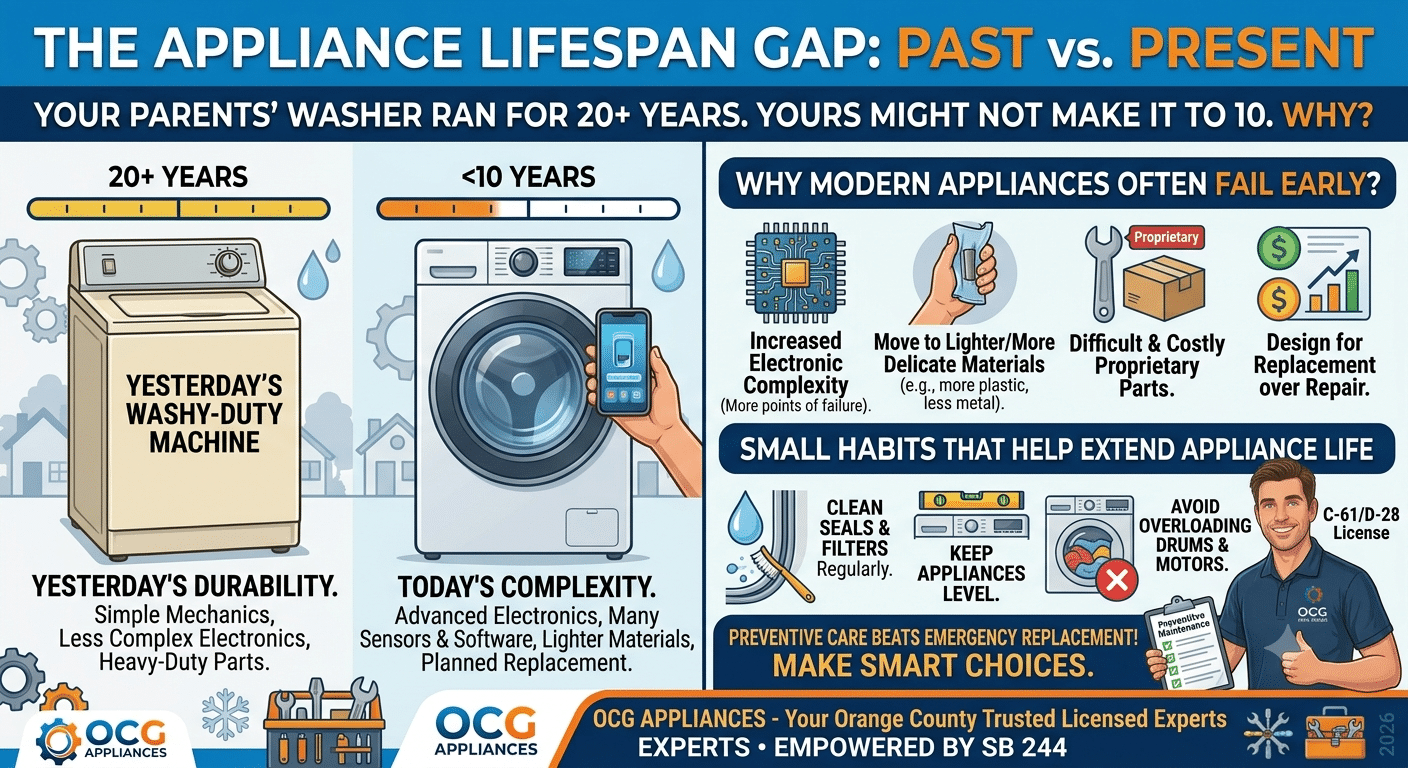
If your parents’ washing machine ran for 20-plus years and your own seems to be limping along at year eight, you’re not imagining things. Consumer advocates and repair technicians alike have increasingly pointed to a real shift: today’s major appliances, on average, don’t last nearly as long as the ones from a generation ago. It’s a common enough observation that it’s become part of the case for right-to-repair laws across the country, including here in California.
Why Modern Appliances Fail Sooner
- More electronics, more failure points. A washer or refrigerator today has circuit boards, sensors, and sometimes WiFi modules that older mechanical-only models simply didn’t have — each one is another part that can fail.
- Design for cost, not just durability. Manufacturing decisions are often driven by keeping retail prices competitive, which can mean lighter-gauge materials, sealed components that are hard to service, and fewer easily replaceable parts.
- Sealed, hard-to-repair assemblies. Some modern components are built as a single sealed unit rather than individually serviceable parts, so a small failure sometimes means replacing a larger, more expensive assembly.
- Tariff and supply chain pressure. Rising material and component costs in 2026 have added pressure on manufacturers to cut costs elsewhere, which doesn’t always favor long-term durability.
The Push Back: Right to Repair
California’s Right to Repair Act (SB 244) is a direct response to this trend — by requiring manufacturers to keep parts and documentation available for years after a model stops being produced, it keeps repair realistic for longer instead of pushing consumers toward early replacement. It won’t make appliances last longer on its own, but it does mean a failing part is more likely to be fixable rather than a dead end.
What You Can Actually Control
Even with modern appliances built the way they are, a handful of habits make a real difference in how long yours last:
- Clean condenser coils and vents regularly — dust buildup makes compressors and motors work harder than they need to, especially during hot Southern California summers.
- Don’t overload washers, dryers, or dishwashers — it’s one of the most common causes of early bearing, belt, and pump failure.
- Use the right detergent and settings — high-efficiency washers in particular are sensitive to the wrong type or amount of detergent.
- Address small issues immediately — a minor leak, unusual noise, or error code left unaddressed often turns into a much bigger (and pricier) failure.
- Get an annual check-up, especially before heat waves or heavy-use holiday seasons, when appliances are pushed hardest.
When Repair Still Makes Sense
Most appliance failures are still a single component — a pump, a control board, a heating element — not the whole unit giving out. Combined with California’s parts-availability protections, that means more appliances are worth repairing today than the “it’s probably cheaper to just replace it” instinct might suggest.
How OCG Appliances Helps
OCG Appliances offers repair and preventive maintenance for major appliances across Orange County — the kind of regular attention that catches small problems before they turn into a full replacement.
FAQ
Are all modern appliances less durable than older ones?
Not universally — but on average, added electronics and cost-driven design choices have shortened typical lifespans for many appliance categories compared to older mechanical-only models.
Does more expensive always mean more durable?
Not necessarily. Price often reflects features, finish, and brand rather than mechanical durability — a mid-range model with simple, well-supported components can outlast a feature-heavy premium one.
Is preventive maintenance actually worth paying for?
For appliances you rely on daily — refrigerators, washers, dryers — yes. Catching a worn part or a small leak early is almost always cheaper than an emergency repair or full replacement later.