Energy-Efficient Refrigerators: What Orange County Homeowners Need to Know in 2025
Your refrigerator never gets a day off. It runs 24 hours a day, 365 days a year — not even during holidays when you’re actually using it the most. For Southern California homeowners on SoCalEdison’s tiered rate structure, choosing an efficient refrigerator and maintaining it properly makes a real, measurable difference on your monthly bill.
How Much Energy Does a Modern Refrigerator Actually Use?
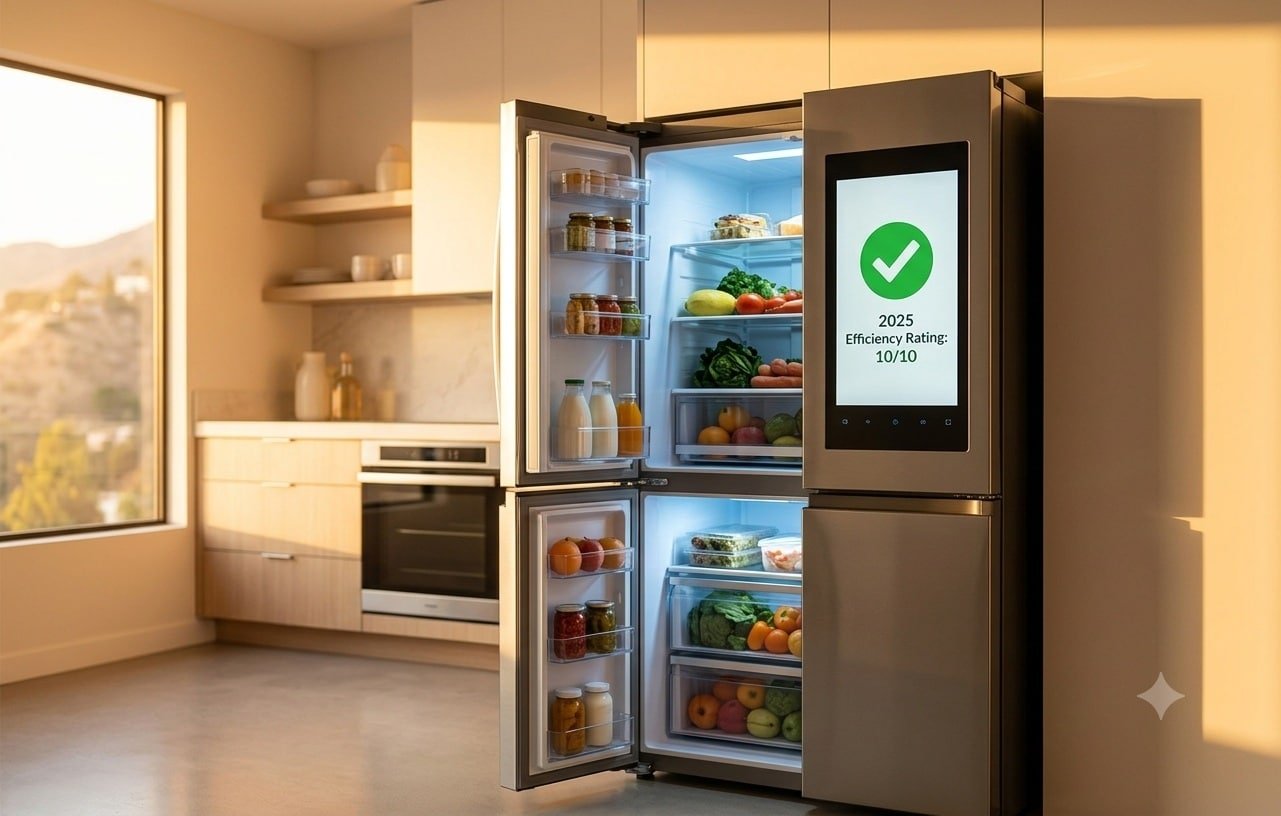
Modern refrigerators (2020 and newer) use surprisingly little energy — as low as 100–200 kWh per year for a standard-sized French door model. Compare that to refrigerators from 2000, which used 600–800 kWh/year. That’s a 70%+ improvement over two decades.
At SoCalEdison’s Tier 2 rate (~$0.35/kWh), a modern efficient fridge costs $35–$70/year to run. An older 2000-era model costs $210–$280/year. The gap is $140–$200 annually — paid every year, forever, until you replace it.
What Makes a 2024–2025 Refrigerator More Efficient?
Inverter and Linear Compressor Technology
Traditional compressors cycle fully on and off. Inverter compressors (Samsung) and linear compressors (LG) vary their speed based on actual cooling demand. This reduces energy consumption, compressor wear, and noise — and it’s why modern fridges last longer despite being lighter-weight overall.
Dramatically Better Insulation
Modern refrigerators use thicker vacuum-panel insulation that reduces heat transfer from your kitchen environment. In warm SoCal kitchens — especially those without AC running at night — better insulation means the compressor cycles far less often.
LED Interior Lighting
All modern refrigerators use LED interior lighting. Old incandescent bulbs generated real heat inside the fridge, forcing the compressor to work harder to compensate. LEDs produce minimal heat and use a fraction of the electricity.
Precision Digital Temperature Management
Digital temperature management responds precisely to actual temperature fluctuations, reducing unnecessary compressor run time compared to older mechanical thermostat systems.
Refrigerator Placement: More Important Than You Think
Where you place your refrigerator significantly affects its efficiency:
- Keep it away from heat sources — don’t place it next to the oven, dishwasher, or in direct sunlight from a south-facing window
- Allow proper clearance — at least 1 inch on each side, 2 inches at the back for condenser airflow
- Avoid hot garages — OC garage temperatures exceeding 90°F in summer force the compressor to work dramatically harder. Garage-rated refrigerators exist for this reason.
Features Worth Paying For in a SoCal Refrigerator
- Inverter or linear compressor — more efficient, quieter, longer-lasting
- Door-open alarm — prevents energy loss from inadvertently left-open doors (especially in households with kids)
- Flexible temperature zones — allows adjusting compartment temps to match what you’re actually storing
- Counter-depth profile — often improves kitchen airflow and looks cleaner in OC open-plan layouts
When to Repair vs. Replace
This is the question we get most often at OCG Appliances. Our honest framework:
- Repair if the fridge is under 12 years old and repair cost is under 40% of replacement cost
- Repair and plan to replace at the next major failure if it’s 12–18 years old
- Seriously consider replacing if it’s over 18–20 years old — the efficiency gains of a modern unit offset a meaningful portion of replacement cost over the next decade
Frequently Asked Questions
Is a larger refrigerator always less efficient? Not necessarily. A properly sized, well-insulated larger fridge with a good inverter compressor can be more efficient than a smaller, outdated model. Compare actual kWh/year figures on the Energy Star label, not just physical size.
What refrigerator brands are most reliable in 2025? LG and Whirlpool consistently rank highly in consumer reliability surveys. Bosch is excellent for counter-depth. Samsung makes feature-rich machines but has had documented ice maker issues in some model years — most are repairable.
Should I buy a refrigerator with a built-in ice maker? Ice makers add approximately $5–$15/year to operating costs and are a common service call item (particularly Samsung). If you don’t need one, skip it. If you do, it’s a worthwhile convenience at minimal energy cost.
Refrigerator repair or efficiency advice in Orange County? OCG Appliances is your local expert. Contact us at ocgappliances.com.