Your 20-Year-Old Washer Might Be Worth More Than You Think
There’s a quiet shift happening in repair shops and utility rooms across Orange County: people are rediscovering that older appliances — the ones built in the 1990s and early 2000s — are often genuinely worth keeping, repairing, and running for many more years.
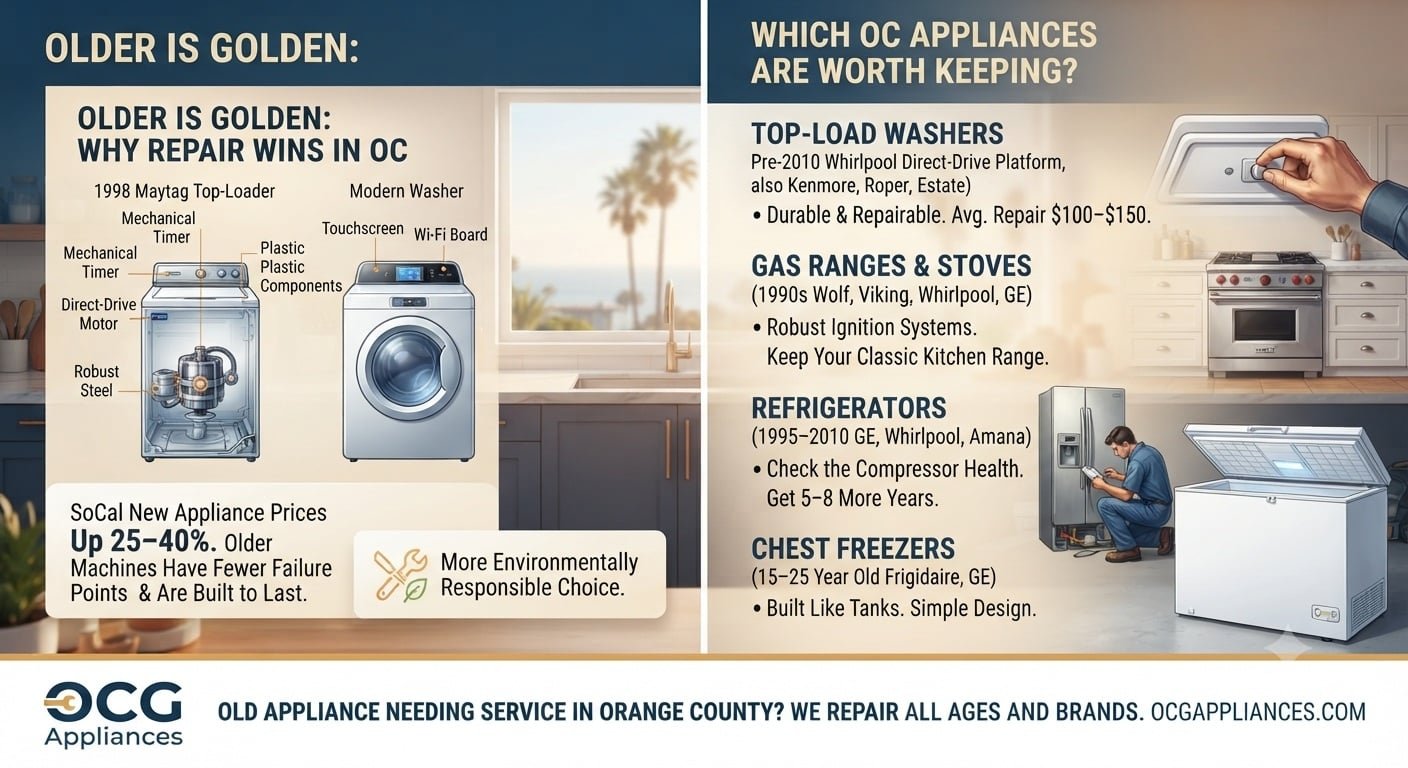
In Southern California, where new appliance prices have surged 25–40% since 2020 and some newer models have documented reliability issues, the case for repairing older machines has never been stronger.
Why Older Appliances Were Built Differently
This isn’t just nostalgia talking. There are real mechanical and engineering reasons why many pre-2005 appliances outlast their modern counterparts:
Fewer electronics. A 1998 Maytag top-load washer has a mechanical timer, a simple lid switch, and a direct-drive motor. No touchscreen, no Wi-Fi board, no digital inverter control. Fewer electronic components means fewer failure points — and when they do fail, the parts are cheap and the repair is straightforward.
Heavier-gauge materials. Cost-reduction pressures over the past two decades led manufacturers toward thinner steel, smaller motors, and cheaper plastics designed for a 7–10 year replacement cycle. Older machines were built to different tolerances.
Repairability was a design principle. Older appliances were engineered with the assumption that a repair technician would service them. Access panels open logically, fasteners are standard, wiring layouts make sense. Many modern appliances are the opposite — complex to access, with proprietary parts that manufacturers restrict to authorized service centers.
Which Old Appliances Are Worth Repairing?
Top-Load Washers (Pre-2010 Whirlpool Platform)
Pre-2010 top-load washers built on the Whirlpool direct-drive platform — also sold under Kenmore, Roper, and Estate brands — are among the most durable washing machines ever mass-produced. The direct-drive motor eliminates the belt, and the transmission is proven over hundreds of millions of cycles. Parts are cheap and abundant. A 20-year-old Whirlpool top-loader with a bad pump or lid switch can be repaired for $100–$150 and continue running reliably for years more.
Gas Ranges and Stoves
A well-made 1990s gas range — Wolf, Viking, or even mid-grade Whirlpool and GE from that era — is usually more robust than a current-generation equivalent. Gas ranges have relatively simple ignition and valve systems, and a 25-year-old Wolf range in a Laguna Hills or Newport Beach kitchen is absolutely worth maintaining. New Wolf ranges cost $5,000–$15,000.
Refrigerators (1995–2010)
Older refrigerators from reliable brands — GE, Whirlpool, Amana — are often worth repairing if the compressor is still healthy. If the sealed refrigerant system is sound, a 20-year-old fridge may have another 5–8 years of service life with proper maintenance. The key question is always: is the compressor good?
Chest Freezers
Old chest freezers are among the most durable home appliances ever built. A 15–25 year old Frigidaire or GE chest freezer in working condition is absolutely worth repairing. Simple design, minimal electronics, robust compressors — they regularly outlast everything else in the garage.
The Environmental Case for Keeping Old Appliances Running
Manufacturing a new appliance consumes significant resources: raw materials, energy, water, and transportation. The “embodied carbon” in a new refrigerator — emissions associated with its manufacture and delivery — takes 5–8 years of energy-efficiency gains to offset against running an older model.
In California, where the electrical grid is increasingly powered by renewables, the efficiency gap between old and new appliances is narrowing in terms of carbon impact. Repairing a sound older appliance is often the more environmentally responsible choice, not just the cheaper one.
When It Actually Is Time to Replace
Not every old appliance deserves rescue:
- Compressor failure on a refrigerator over 18 years old — usually replacement territory
- Multiple simultaneous failures suggesting the machine is in systemic decline
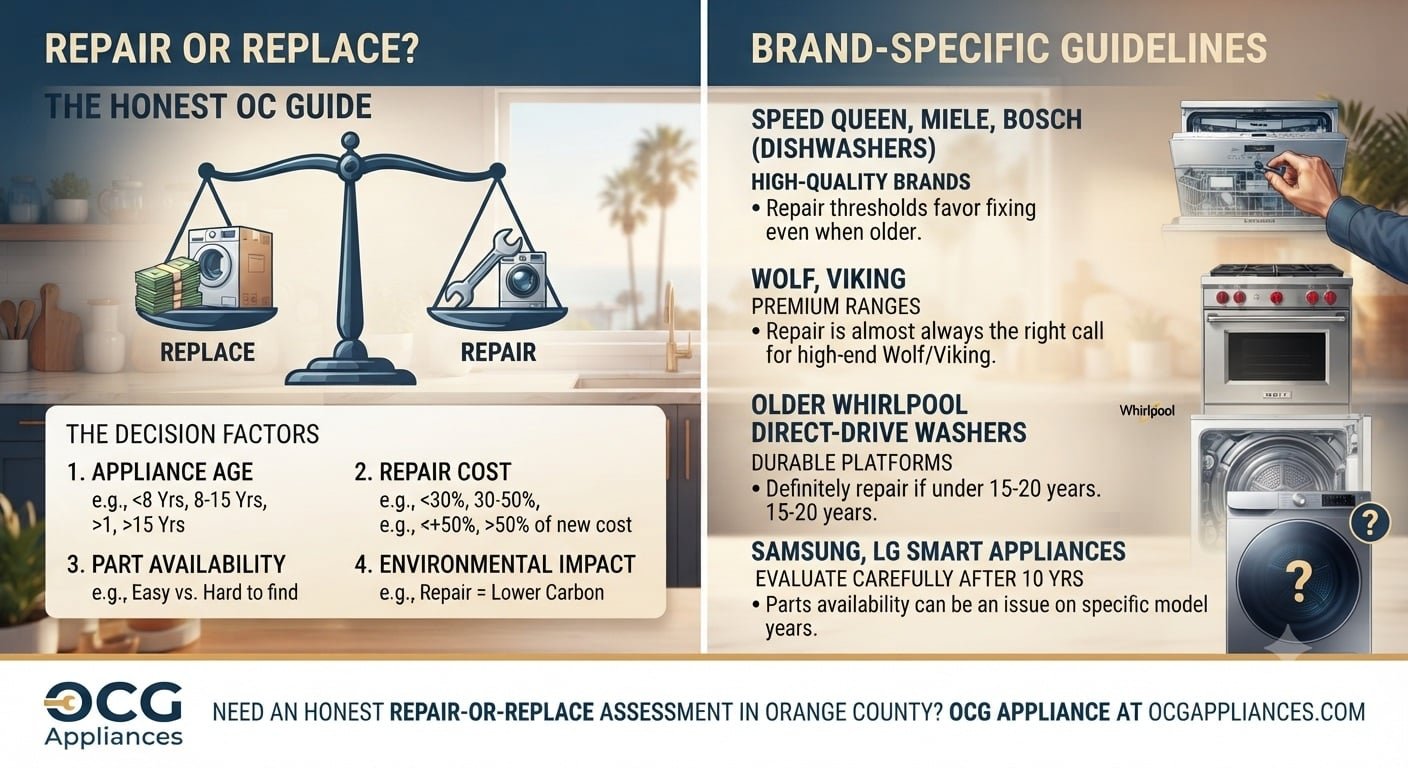
- A repair cost exceeding 50–60% of replacement — the math shifts toward replacement
- Unavailable parts — though this is rarer than people assume (call us before giving up)
Frequently Asked Questions
My 18-year-old Maytag washer still works great. Should I replace it proactively? No. If it’s running well, there’s no financial or environmental reason to replace it. Continue regular maintenance and repair it when issues arise. Many OC households have Maytag and Whirlpool top-loaders from the early 2000s still running daily.
Parts for my old appliance are hard to find — now what? Call OCG Appliances before giving up. We have access to aftermarket and NOS (new old stock) parts for many older appliance models. What’s unavailable at Home Depot is often obtainable through specialty suppliers we work with regularly.
Is a repaired old appliance as reliable as a new one? For a machine with a clean mechanical history and a single repair, often yes. We’ll tell you honestly when we think an appliance has reached the end of its reliable service life — we have no interest in recommending repairs that won’t hold.
Old appliance needing service in Orange County? We repair all ages and brands. Visit ocgappliances.com to schedule.