Old Is Gold: Why Vintage Appliances Outlast Modern Ones
Walk into enough Orange County homes and you’ll find them: the Kenmore washer in a Laguna Hills garage that’s been running since 1989. The stainless Wolf range in a Dana Point kitchen that’s older than the homeowner’s youngest child. The Amana side-by-side refrigerator in a Brea utility room that’s been faithfully keeping groceries cold for 22 years.
These aren’t anomalies. They’re a reminder that appliance durability was once a primary engineering goal — and that many vintage machines, properly maintained and repaired when needed, genuinely outlast their modern replacements.
The Build Quality Gap: Why Older Machines Last Longer
The 1970s through the late 1990s represented something of a golden era for appliance manufacturing. Several factors converged to produce exceptionally durable machines:
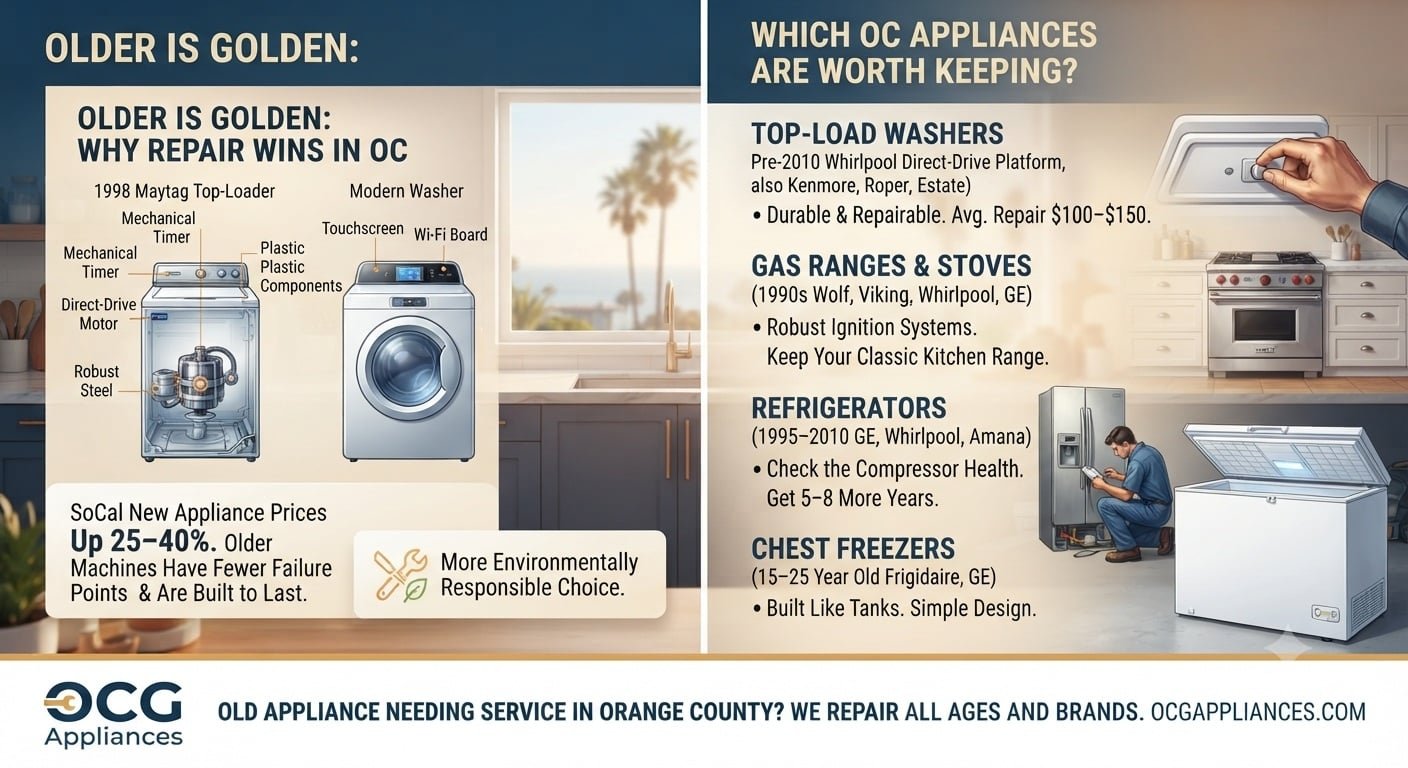
Materials built for decades. Heavier steel cabinets, porcelain-coated cast iron drums, and thicker plastics designed for 20+ year service lives. Modern cost-reduction pressures have shifted manufacturers toward materials sized for 8–12 year replacement cycles.
Over-engineered mechanical systems. Direct-drive motors in Whirlpool washers, robust gas valve assemblies in ranges, and proven simple compressor designs in refrigerators. These systems were built with margins that gave them long, reliable service lives.
Repairability by design. Older appliances were engineered with the assumption they’d be repaired. Logical access panels, standard fasteners, clearly labeled components. Many modern appliances trend toward proprietary designs that require specialized tools and restrict parts availability to authorized dealers.
The Vintage Appliances Known for Legendary Longevity
Whirlpool Direct-Drive Washers (1982–2010)
This platform — also sold under Kenmore, Roper, Estate, and Inglis brands — is arguably the most durable washing machine design ever mass-produced for the residential market. The direct-drive motor eliminates the belt as a wear item, and the six-button transmission is proven over hundreds of millions of operating cycles. Parts remain inexpensive and widely available. Any technician familiar with this platform can fix virtually any failure mode. These machines are the gold standard for repairability.
Speed Queen Washers and Dryers (Any Era)
Speed Queen commercial-grade residential machines are the definitive longevity benchmark. Designed originally for laundromat use and adapted for home installation, they’re built to run 10,000+ cycles without failure. A well-maintained Speed Queen from the 1990s is a genuine heirloom appliance — and the company still builds to similar standards today, making them the go-to for OC homeowners who genuinely want a machine they’ll never replace.
Wolf and Viking Gas Ranges
Professional-grade cooking equipment is engineered to last indefinitely with maintenance. A 25-year-old Wolf or Viking range with igniter issues, a bad valve, or a worn thermostat is absolutely worth repairing — new Wolf ranges cost $5,000–$20,000 and a repair on a vintage one often runs $150–$300. Parts remain available and our technicians know these platforms well.
Older Frigidaire and GE Chest Freezers
Minimal electronics, simple compressor, robust insulation. Chest freezers from the 1980s and 1990s routinely outlive their owners. When they fail, it’s almost always the start relay ($10–$20 part) or the thermostat — not the compressor. These are among the easiest and most cost-effective repairs we do.
Pre-2000 Sub-Zero Refrigerators
Original Sub-Zero refrigerators from the 1980s and 1990s were built to commercial standards for residential kitchens. Many are still running in OC homes today. Parts availability is excellent through Sub-Zero’s parts program, and the sealed refrigerant systems on these machines are genuinely robust. A vintage Sub-Zero that needs a thermostat or door gasket is absolutely worth keeping.
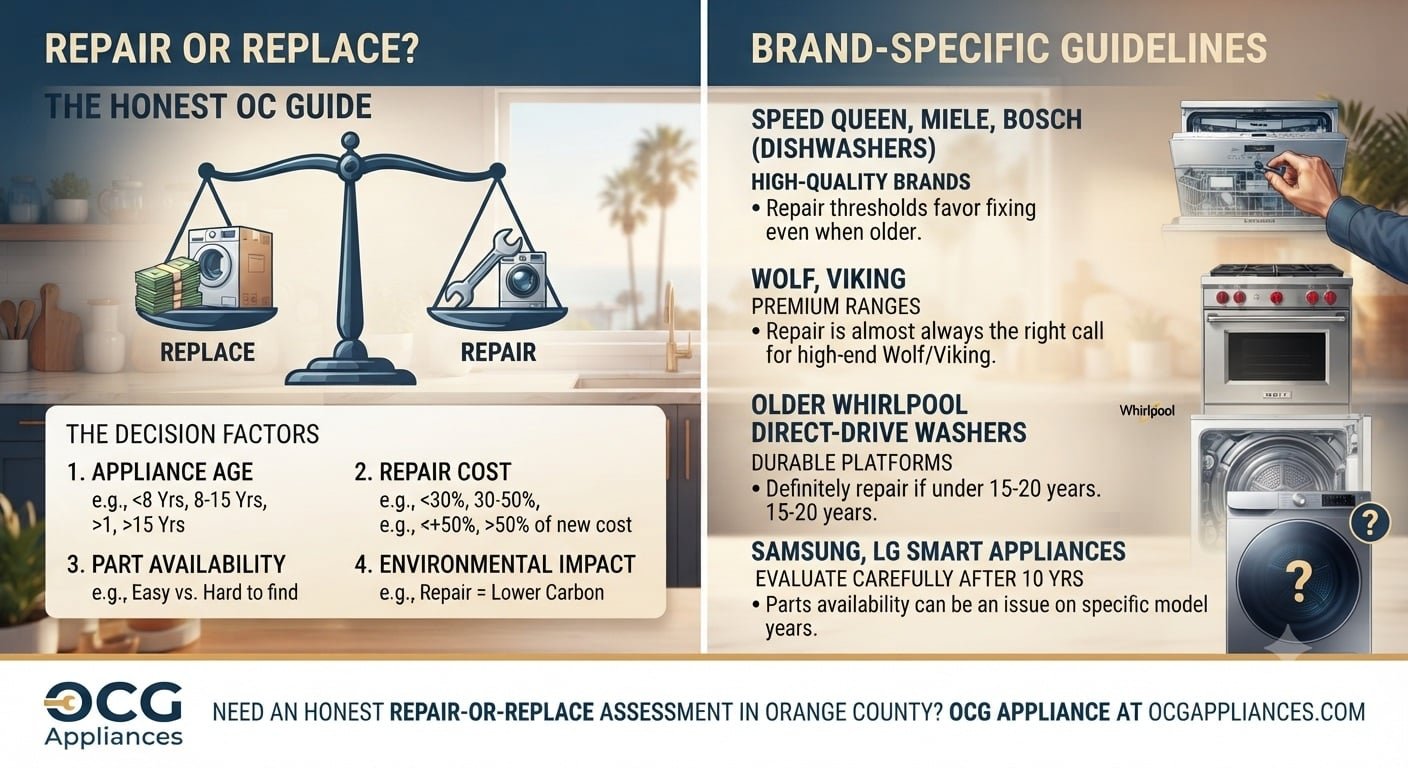
The Repairability Test: Three Questions to Ask
Before deciding whether to repair any vintage appliance, ask:
- Are parts available? Call us before assuming they’re not — our specialty parts network covers far more legacy models than HomeDepot or Amazon would suggest.
- Is the core mechanical system healthy? A working compressor, motor, or drum is the foundation everything else is built on. If the core is sound, surface failures are almost always worth fixing.
- What’s the repair cost relative to current replacement cost? With new appliance prices significantly elevated since 2020, the repair threshold has shifted substantially in favor of keeping older machines running.
When Vintage Becomes a Liability
Honest exceptions to the “old is gold” rule:
- Very old refrigerators (pre-1993) using CFC refrigerants (R-12) — legal to repair, but the coolant is expensive and increasingly scarce
- Machines with multiple simultaneous failures indicating broad system decline
- Cases where the specific repair cost genuinely exceeds replacement value
These situations are real but genuinely uncommon for well-built vintage appliances. For most single-failure scenarios on quality older machines, repair is the right call.
Frequently Asked Questions
Is it environmentally responsible to keep running a 20-year-old appliance? Often yes — especially on California’s increasingly renewable grid. The carbon cost of manufacturing a new appliance is substantial. A well-maintained vintage appliance running efficiently (clean coils, good seals, calibrated thermostat) can have a lower full-lifecycle carbon footprint than a new replacement when manufacturing emissions are factored in.
My vintage appliance brand doesn’t exist anymore — can you still get parts? Usually yes. Many brands were absorbed by larger manufacturers (Maytag by Whirlpool, Frigidaire by Electrolux, Jenn-Air by Whirlpool), and original parts are often interchangeable. Aftermarket suppliers cover a huge range of legacy models. We’ll tell you honestly if something genuinely isn’t available.
Vintage appliance needing service in Orange County? OCG Appliances respects and repairs old iron. Schedule at ocgappliances.com.